
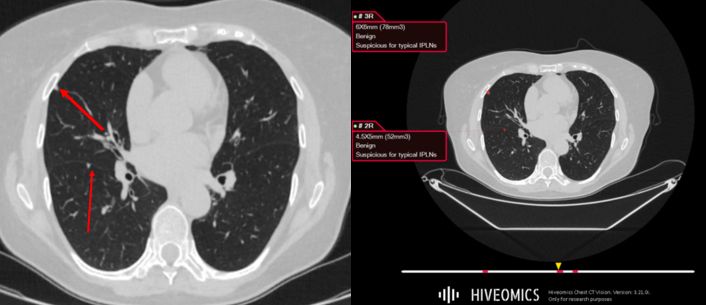
Why This Problem Matters
Chest CT has become one of the most common diagnostic procedures worldwide. It identifies millions of pulmonary nodules — but only a minority represent cancer.
A significant portion of small solid nodules, up to 45%, are actually intrapulmonary lymph nodes (ILNs), also referred to as perifissural nodules (PFNs). These are normal anatomic structures that:
- often appear suspicious,
- may grow over time,
- cause concern for clinicians and patients,
- lead to unnecessary follow-up imaging and invasive procedures.
Yet numerous studies show:
ILNs are not associated with lung cancer risk — even in oncologic populations.
However, their appearance varies widely, and radiologist assessment is highly subjective. Inter-observer agreement is only moderate, creating a need for a robust tool that can automatically and consistently classify these nodules.
What the Clinical Community Needed
Our mission was to create a solution that:
- reliably distinguishes ILNs from potentially malignant nodules,
- works both in screening and oncologic settings,
- reduces false positives,
- accelerates CT interpretation,
- brings confidence where uncertainty used to exist.
This is how the initiative to develop an AI model for ILN classification began.
How the Hiveomics Model Was Built
- Large Expert-Annotated Dataset
The model was trained on multiple datasets:
- internal Hiveomics clinical corpora,
- specialized research datasets,
- screening cohorts,
- oncologic patient datasets.
Annotations were performed by radiologists experienced in PFN morphology — crucial given the known variability in human interpretation.
- Formalizing PFN Morphological Criteria
We incorporated well-established CT criteria, including:
- proximity to pleura (≤10–15 mm),
- attachment to a fissure or thin septum,
- smooth, well-defined margins,
- oval, lentiform, or triangular shape,
- diameter up to 12 mm,
- absence of vascular connection,
- preference for lower-lobe locations.
These principles formed the structural backbone of the model.
- The Model Architecture
The Hiveomics AI combines:
- a 3D convolutional neural network optimized for small solid structures,
- a shape-analysis module,
- radiomic descriptors of local anatomy,
- a spatial-attention block highlighting pleural and fissural regions.
The Result: A Reliable Tool for Real-World Radiology
High Accuracy
The model achieves:
- AUC ~0.95,
- sensitivity >90%,
- specificity >85%.
These metrics match or exceed those reported in major international PFN-classification studies.
Reduced Interpretation Variability
Where radiologists often disagree, the model provides consistent results — reducing diagnostic uncertainty and improving decision-making.
Confidence in Difficult Cases
Even when a nodule:
- grows,
- lies against the pleura,
- appears in a cancer patient —
the model supports differentiation between benign and malignant lesions.
Seamless Integration Into the Hiveomics Ecosystem
The ILN classifier functions within the broader platform:
- full nodule detection,
- malignancy risk scoring,
- structured reporting.
Turning CT analysis into a structured and optimized process.
Conclusion
Developing an AI model for intrapulmonary lymph node classification marks a significant step forward:
- less uncertainty,
- fewer false positives,
- more efficiency,
- more confidence.
This is how we envision the future — where artificial intelligence empowers clinicians to see more than ever before.